
ROOT CANAL TREATMENT (RCT)
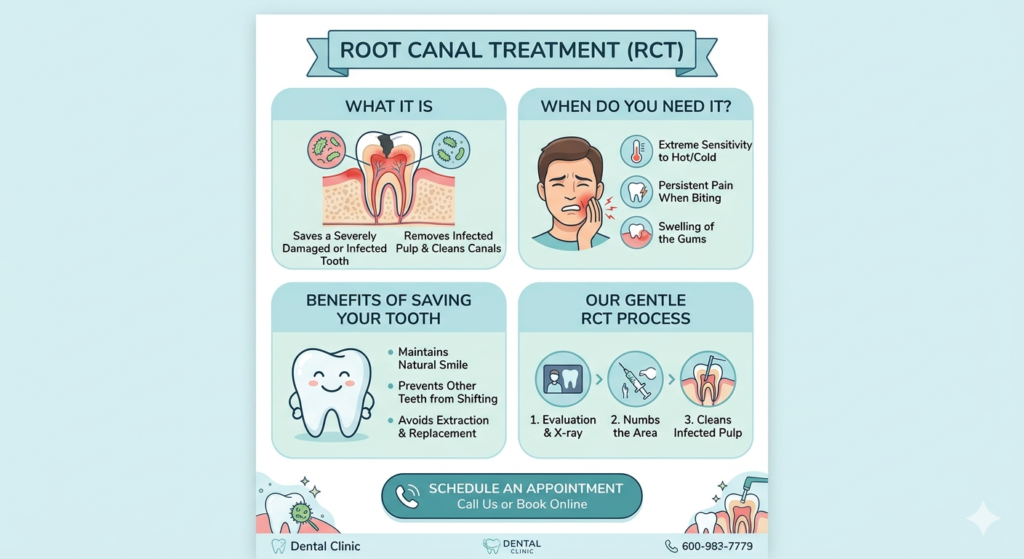
An Root Canal Treatment (RCT) page is one of the most important pages on a dental website. Because many patients feel anxious about this specific procedure, this copy is designed to be highly reassuring, empathetic, and clear, busting common myths while explaining the process transparently.
Root Canal Treatment: Fast Relief and Saving Your Natural Tooth
If you are experiencing severe tooth pain, swelling, or extreme sensitivity to hot and cold, you may need a Root Canal Treatment (RCT).
While root canals have an old reputation for being intimidating, modern dental technology has completely transformed the procedure. Today, getting a root canal is no more uncomfortable than receiving a routine filling. In fact, the main goal of a root canal isn’t to cause pain—it’s to instantly relieve it and save your natural tooth from extraction.
What is a Root Canal Treatment?
Deep inside every tooth is a soft tissue area called the pulp. The pulp contains the tooth’s nerves, blood vessels, and connective tissues. If a deep cavity, a cracked tooth, or a physical injury allows bacteria to enter this inner chamber, the pulp becomes infected, inflamed, and painful.
A root canal treatment is a precise, routine procedure where your dentist cleans out this damaged tissue, sterilizes the inner channels of the tooth, and seals it up to prevent future infections.
Why Saving Your Natural Tooth Matters
When a tooth pulp becomes severely infected, the only two options are a root canal or completely pulling the tooth (extraction). Whenever possible, we always recommend saving your natural tooth.
- Keeps Chewing Efficient: Nothing eats or bites quite as well as your natural teeth.
- Prevents Teeth Shifting: Pulling a tooth leaves a gap. Over time, neighboring teeth will tilt and drift into that empty space, completely throwing off your bite alignment.
- Saves Money Long-Term: While an extraction is cheaper upfront, replacing that missing space later with an implant or a bridge to restore your smile will cost significantly more time and money.
Step-by-Step: The Root Canal Process
We use advanced digital imaging and highly effective local numbing to ensure your visit is completely relaxed and pain-free.
1.Numbing and Preparation:Step 1.
We apply a powerful local anesthetic to completely numb the infected tooth and the surrounding gums. You will feel zero pain during the procedure—just a bit of standard pressure.
2.Removing the Infection:Step 2.
The dentist creates a tiny, microscopic opening in the crown of the tooth. Using highly specialized, flexible micro-instruments, they carefully remove the diseased, painful pulp tissue from the root canals.
3.Cleaning and Shaping:Step 3.
Once the pulp is removed, the canals are thoroughly flushed with an antibacterial solution to disinfect the entire interior structure of the tooth. The canals are then shaped to prepare them for sealing.
4.Filling and Sealing:Step 4.
The empty canals are filled with a biocompatible, rubber-like material called gutta-percha. This is sealed tightly with adhesive cement to guarantee no bacteria can re-enter.
5.The Final Restoration:Step 5.
Because a tooth without a nerve becomes brittle over time, we highly recommend protecting it with a custom porcelain dental crown. This fully restores the tooth’s original strength, structure, and appearance.
True or False: Common Root Canal Myths
Myth: “Root canals are incredibly painful.”
The Reality: This is completely false. The pain comes from the infection itself pressing on your dental nerve, not the treatment. The root canal procedure actually eliminates that pain. Most patients experience immediate relief after their appointment.
Myth: “It’s better to just pull the tooth.”
The Reality: Keeping your natural teeth is always the best option for your long-term oral health, facial structure, and wallet. An extraction should only be a last resort.
Don’t Ignore the Pain—We Can Help
Dental infections do not clear up on their own, and delaying treatment can lead to painful abscesses or tooth loss. If you are experiencing pain, our gentle, compassionate team is ready to help you find relief today.
Relieving Pain and Saving Your Tooth: A Root Canal Story
Many people associate “root canal” with pain, but the reality is quite the opposite. This routine procedure is designed to stop the intense pain caused by infection deep within your tooth and save your natural tooth. Let’s look closer at how this treatment works.
Inside Your Tooth: Where the Trouble Starts
Healthy teeth have several layers. The white, visible outer layer is enamel, the hardest substance in your body. Below that is dentin, a slightly softer layer. The core of the tooth is the pulp chamber, which houses the pulp—a soft tissue rich in nerves and blood vessels.
When deep decay, a serious fracture, or a severe injury damages the tooth, bacteria can invade the pulp chamber. This triggers inflammation and infection, causing pressure to build and leading to significant pain and sensitivity.
Step 1: Locating the Source of the Infection
The journey to relief begins with a precise diagnosis. We don’t just look at the outside of your tooth; we need to see what’s happening underneath.
During your initial consultation, we will perform a careful examination. We often take detailed dental x-rays or 3D scans. These allow us to see the entire root system and assess the health of the bone surrounding the tooth, identifying exactly where the infection is located and how to proceed.
Step 2: The Procedure – Relieving the Pressure
The procedure itself is surprisingly straightforward and focuses entirely on your comfort. Before we begin, we use an effective local anesthetic to fully numb the tooth and the entire surrounding area. Most patients feel little to no discomfort, comparable to receiving a routine filling.
Once you are completely comfortable, we make a microscopic opening in the tooth’s crown to access the pulp chamber. We use advanced, flexible tools—often with micro-endodontic microscopes—to gently remove the damaged and infected pulp from inside the tooth’s root canals. This instantly relieves the pressure and eliminates the infection.
Step 3: Restoring Strength and Function
After the canals are meticulously cleaned and disinfected, they are carefully filled and sealed to prevent any new bacteria from entering. However, a tooth without its nerve and blood supply becomes more brittle and weaker over time.
To protect the remaining tooth structure from fractures and fully restore its biting and chewing power, we highly recommend finishing the treatment with a custom-made porcelain dental crown. The finished product looks and functions exactly like your natural tooth, ensuring its long-term survival in your smile.